- RSnake Report
- Posts
- RSnake Report 20251228
RSnake Report 20251228
Maritime seizures, the US holy war, etc

Robert "RSnake" Hansen
December 28, 2025

What's In the News
Hello, and thanks for reading! I hope you all had a nice Xmas. We had a small get-together with some friends who don’t have family in town on Xmas eve, and a smaller family-only thing on Xmas. I managed to avoid doing any meaningful work, so it was pretty relaxing, other than a flat tire, to throw a curveball into the mix. Also, on the funnier side, a buddy of mine left these fake $100 bills around on cars, and it made me laugh:

In Russia/Ukraine news, Swedish customs officials and the coast guard detained the Russian container ship Adler in territorial waters due to the absence of a mandatory customs declaration. The vessel's owner faces EU and U.S. sanctions for transporting weapons used in the war against Ukraine. Officials boarded the ship, and the inspection continues without announced results, which sorta shows how unreliable shipping is getting. Also, a Turkish-flagged cargo ship traveling from Ukraine to Turkey was struck by an attack drone in the Black Sea's international waters, with preliminary information pointing to Russia as the perpetrator. This is the fourth such attack on Turkish vessels by Russia in the past month. Shipping is getting sanctioned all over the place and on many different fronts, which you will see as we go further into the report this week.
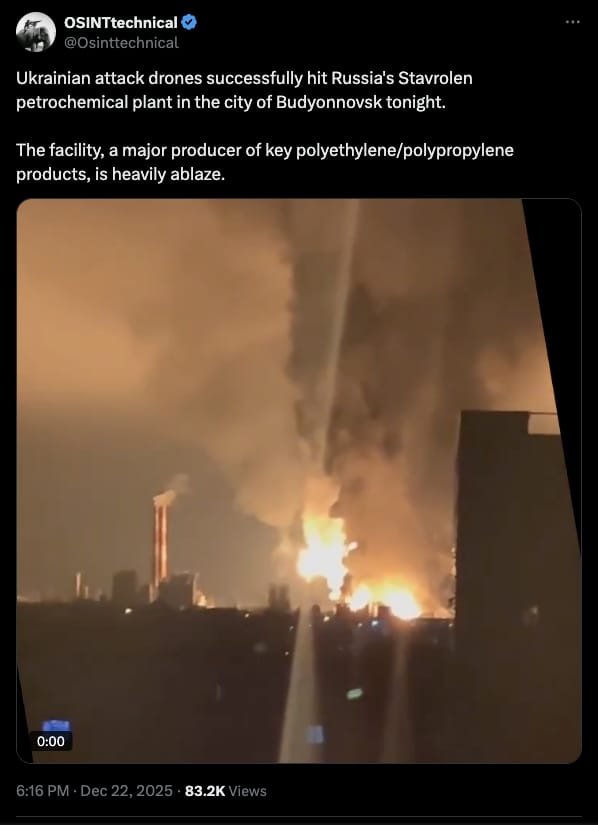
Ukrainian attack drones struck Russia's Stavrolen petrochemical plant in Budyonnovsk, causing a pretty notably large fire at the facility that produces key polyethylene and polypropylene products.
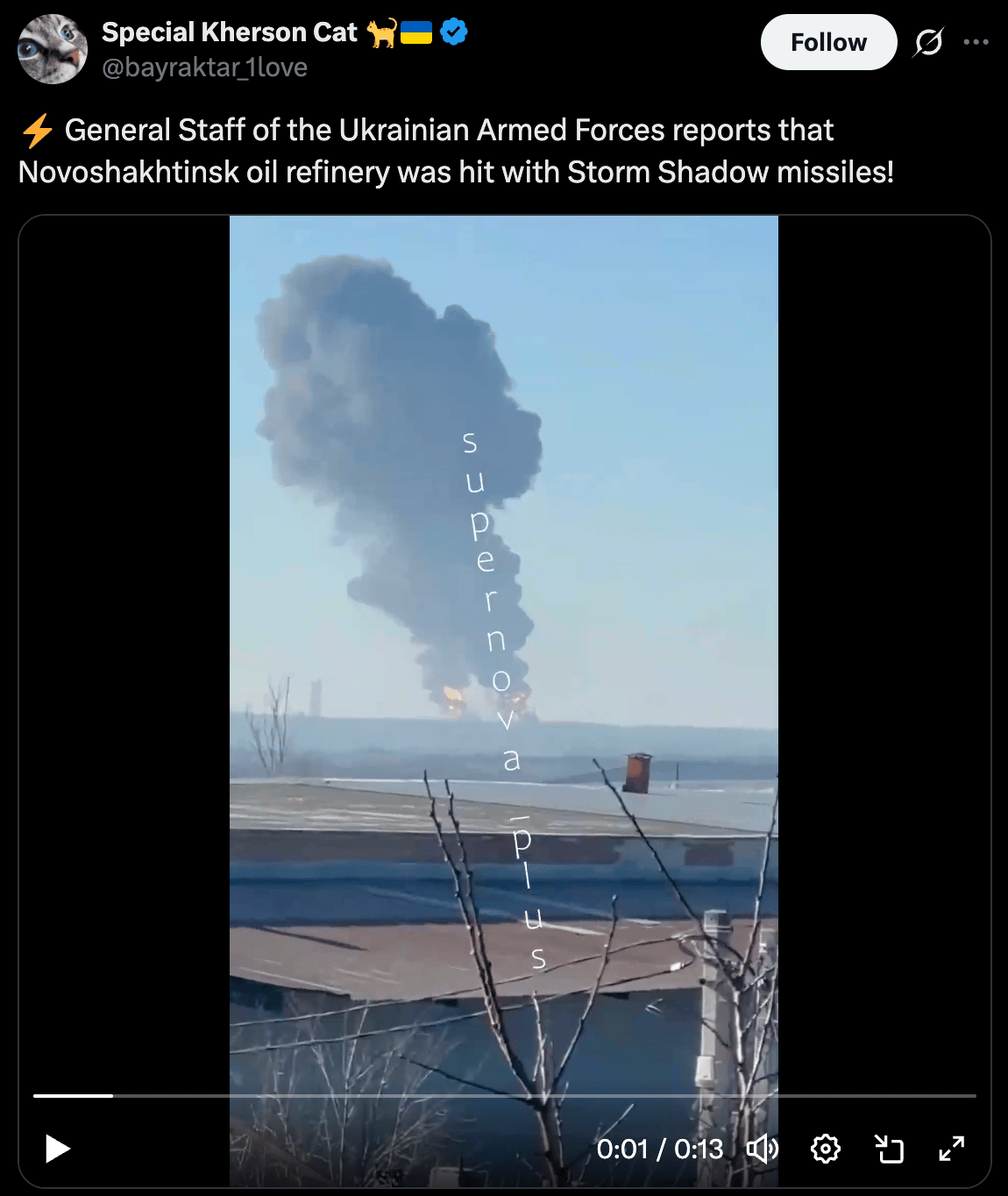
The Ukrainian Armed Forces' General Staff also reported that Storm Shadow missiles hit the Novoshakhtinsk oil refinery. These attacks on oil and gas infrastructure aren’t coming as fast as they have been over the previous few months, but likely because much of the infrastructure is still damaged and under repair, is my guess. Why waste the weaponry?
Ukraine's SBU conducted a special operation that destroyed an Il-38N naval reconnaissance aircraft at Yeisk airbase before sinking a submarine in Novorossiysk that we covered last week. The aircraft, valued at $24 million, had opposed SBU naval drones and was the lone aircraft capable of identifying exactly this type of submersible sea baby drone that was used against the submarine. The SBU used a modern drone with a surface-to-surface explosion warhead.

Ukrainian attack drones targeted the Russian navy base at Chornomorske in occupied Crimea overnight, striking air defense infrastructure and a naval drone base multiple times. Ukraine's Security Service also released footage of strikes on Russian air defense systems, including S-400, S-300, Pantsir-S1, Buk-M2, Buk-M3, Tor, Osa, and Strela-10 units, plus radar stations, command posts, and detection assets. That is a lot of air defense gone in a very short amount of time. It says to me that Ukraine is inching towards air superiority.

Adding to that theory, Ukrainian forces developed a sniper pod and low-cost air-to-air missiles for drone use. These are $35k a piece, and are accounting for a large chunk of the cruise missile hits. But the fact that F-16s, which aren't exactly known for stealth, are flying around unmolested is proving to me that it’s getting relatively safe for Ukraine to fly.

Ukraine recorded its first loss of an M1A1 AIM tank supplied by Australia. The vehicle features angled ERA armor on the turret cheeks and solid spaced armor on the roof, differing from the M1A1SA variant. It looked already abandoned, so it’s not clear if this was taken out by drones or failed for other reasons, but Russia was quick to take the win. That said, the heaviest equipment is often put in the worst possible positions because they can take more damage, so it’s not terribly surprising to see a loss of a single US-produced tank, of a less armored variant.
The Ukrainian-developed Predator anti-drone combat module, from UGV Robotics, integrates on stationary positions or mobile platforms like armored vehicles, trucks, helicopters, and unmanned surface vessels. It mounts 7.62 mm machine guns such as PKM or M240, with an optional thermal camera, laser rangefinder, and automatic grenade launcher. These and similar systems are going to get more popular for close-in air support, especially when combined with robotic complexes. So let’s cover off on what’s going on in that area for a moment.

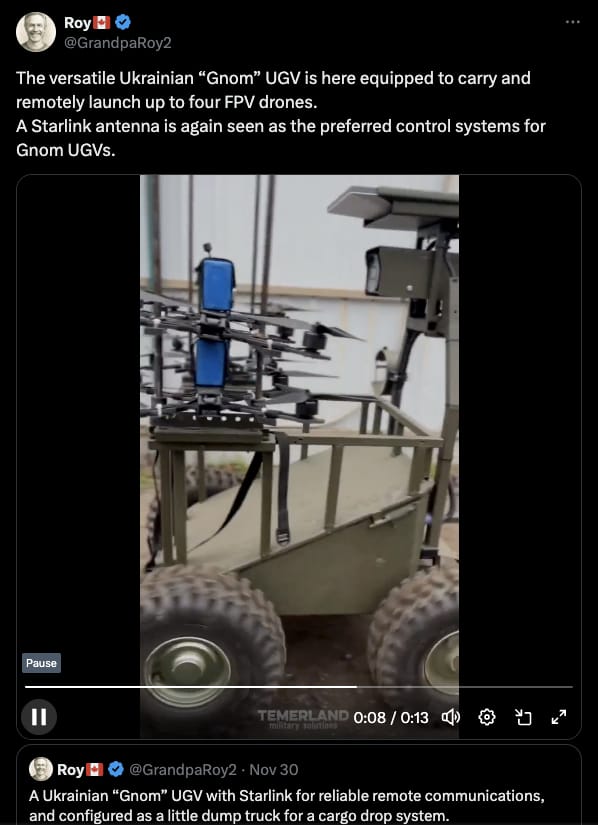
I spotted a Ukrainian Gnom UGV, which carries and remotely launches up to four FPV drones, using a Starlink antenna for control. So this reduces the cost of drones because they can be transported closer, requiring fewer batteries, etc. But it also means they can be closer to the target and respond faster.
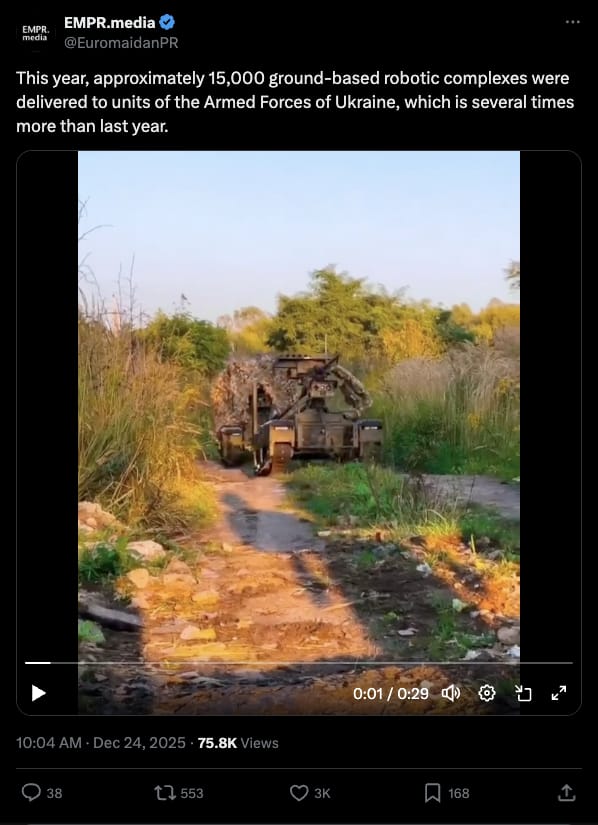
Meanwhile, Ukraine delivered approximately 15,000 ground-based robotic complexes to its armed forces this year, a several-fold increase from last year, with many equipped with machine guns. That means they can act as repeaters, air defense, ground defense, or as transport. Pretty huge implications, especially because they keep the operators at a distance.
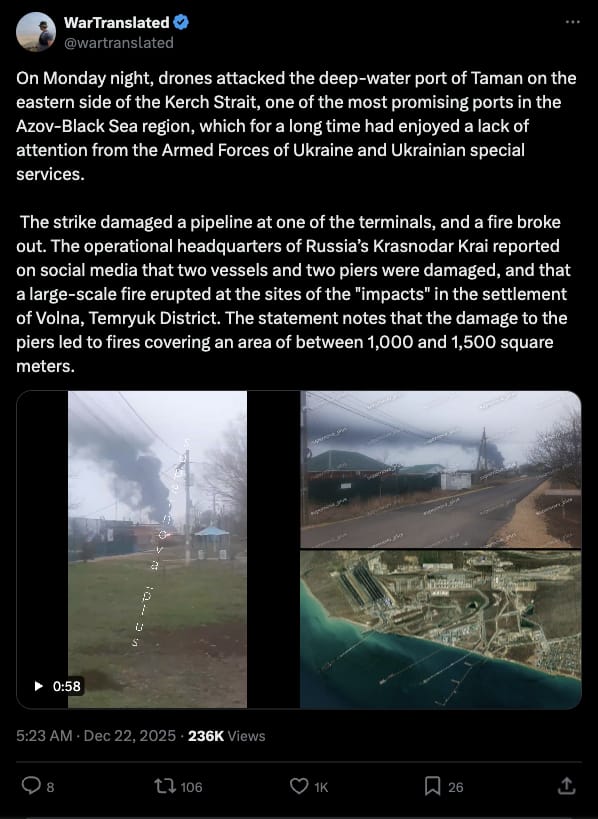
Drones attacked the Taman deep-water port on the Kerch Strait's eastern side, damaging a pipeline at a terminal and igniting a fire. Russia's Krasnodar Krai operational headquarters reported damage to two vessels and two piers, with fires covering 1,000 to 1,500 square meters in the Volna settlement of Temryuk District.
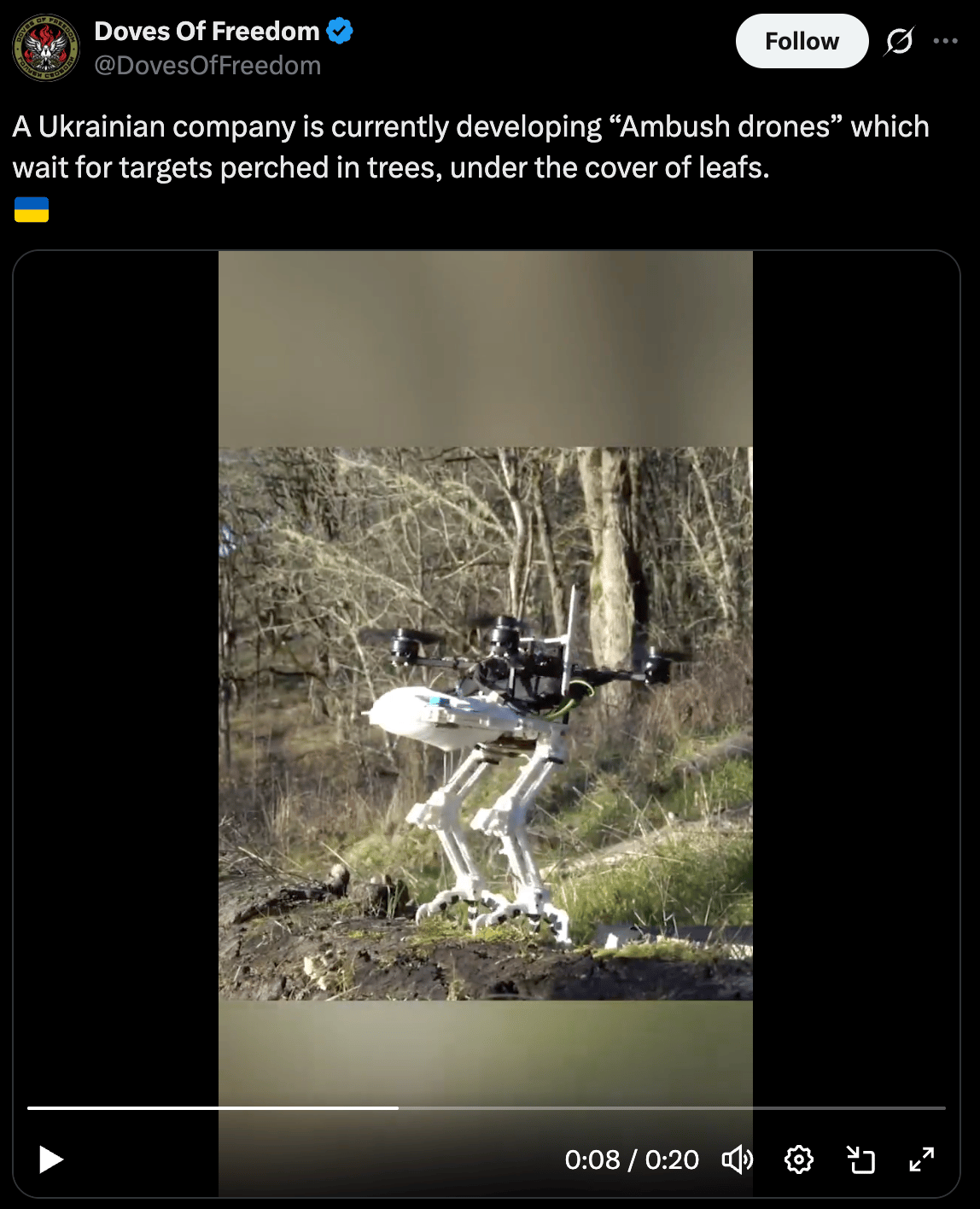
A interesting little innovation originating from researchers at Stanford has made it to Ukraine where a company is developing ambush drones that perch in trees under leaf cover to wait for targets. This is a different type of ambush drone because it can sit higher and sense targets at a much larger distance than the roadside variants we have been seeing thus far.
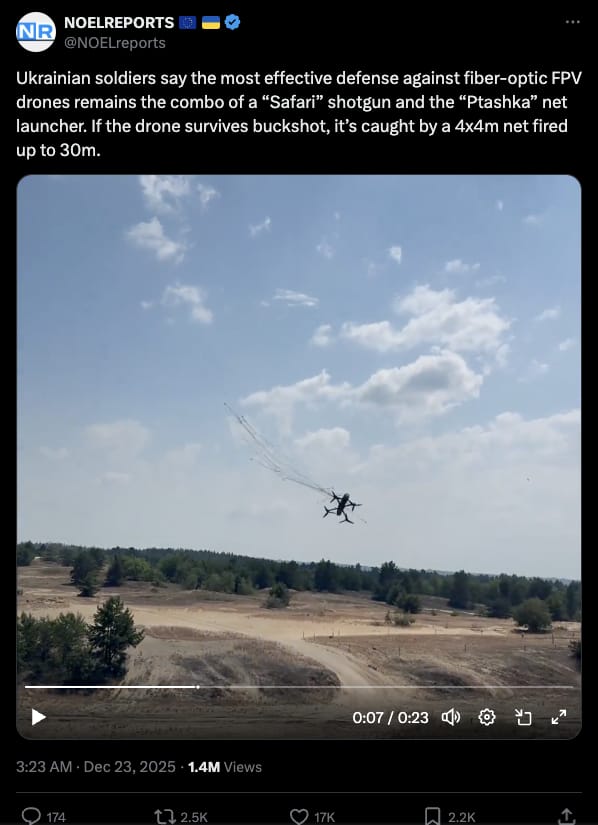
Ukrainian soldiers have shown some success in the use of a Safari shotgun combined with the Ptashka net launcher as the most effective defense against fiber-optic FPV drones. The 4x4-meter net fires up to 30 meters. I have a feeling this really is the correct way to defend against many drones that don’t have protected/caged propellers, and that this could actually use a lot of improvement.
Harking back to the Middle Ages, Ukrainian forces repelled a Russian cavalry assault using horses in Donetsk Oblast. Russian milblogger Military Informant noted horses' increasing use in frontline supply and logistics. Additional videos show Russians employing horses in assaults and logistics, alongside bicycles when horses and donkeys run short. This implies that Russia is running out of any sort of vehicles, let alone armor. This could also be due to supply issues, like access to fuel and oil for the front lines.

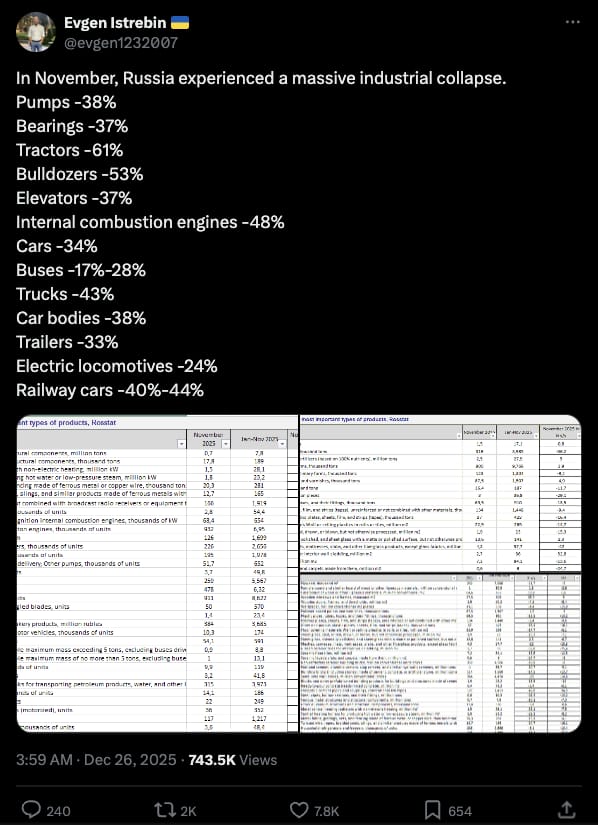
Dmytro Biletskyi, commander of Ukraine's 3rd Army Corps, stated that Russia is failing to replenish its losses for the first time, with more soldiers and equipment like armored vehicles and artillery systems being destroyed than replaced. Russia's industrial output collapsed in November, with declines including pumps at 38%, bearings at 37%, tractors at 61%, bulldozers at 53%, elevators at 37%, internal combustion engines at 48%, cars at 34%, buses at 17-28%, trucks at 43%, car bodies at 38%, trailers at 33%, electric locomotives at 24%, and railway cars at 40-44%.
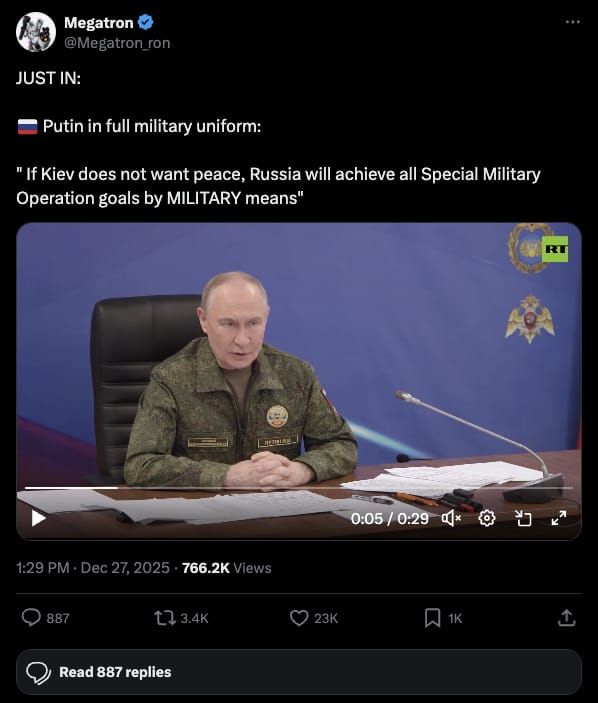
Russian President Vladimir Putin stated that Russia will not attack Europe if Western nations treat Moscow with respect and avoid threats to Russian interests. Never mind that Ukraine is in Europe, and he lied about not invading Ukraine previously. So I can sense why no one trusts him. However, Putin does not seem to be capitulating either. He said that Russia will achieve its SMO goals by military means if Kyiv doesn’t accept peace. That also means, of course, giving up huge amounts of territory in Ukraine’s east. Per usual, he threw on some camo garb to stress his point.
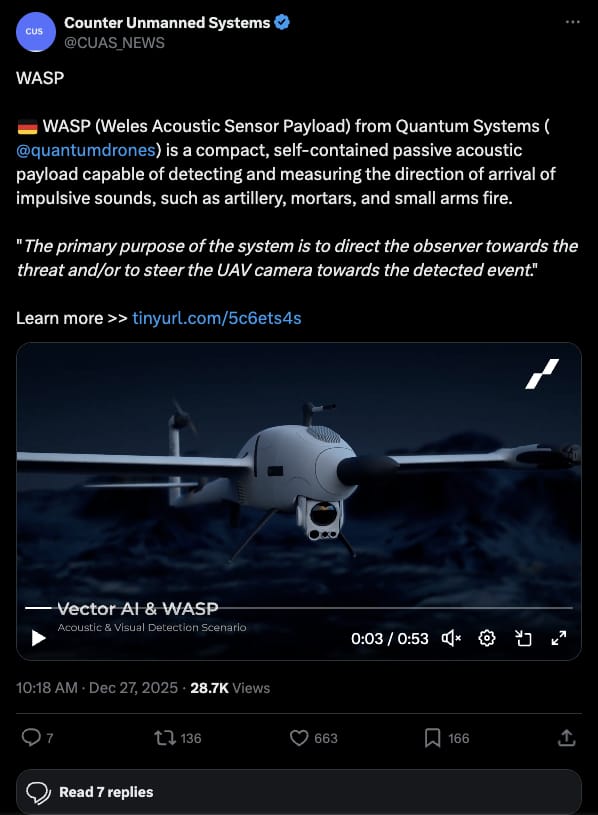
In European news, the WASP acoustic sensor payload from Quantum Systems detects and measures the direction of impulsive sounds like artillery, mortars, and small arms fire. It directs observers or UAV cameras toward threats. This is quite similar to the shot detection systems being used by the police and the military. The difference is that this is right next to some potentially very noisy UAV rotors and still able to function, which is pretty impressive.
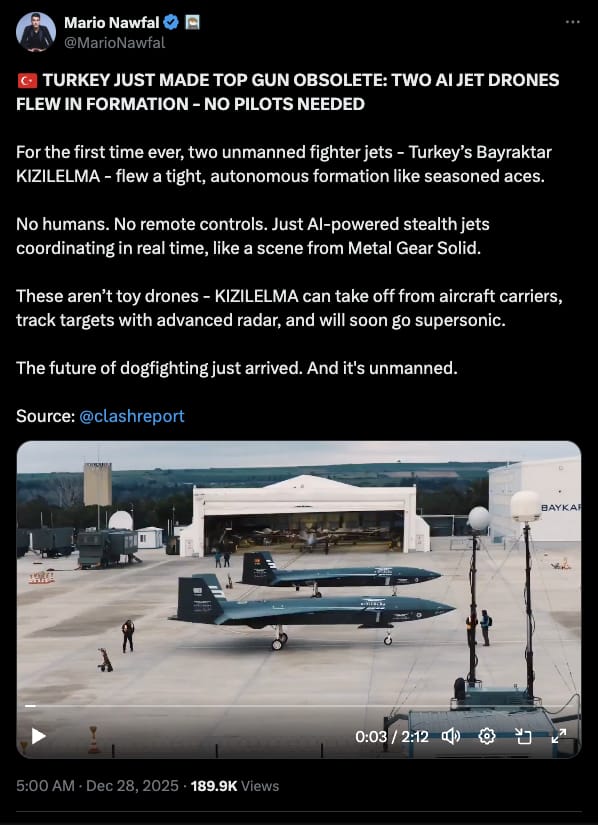
Turkey's Bayraktar KIZILELMA unmanned fighter jets flew in autonomous formation without pilots or remote controls, using AI for real-time coordination. The jets potentially operate from aircraft carriers, feature advanced radar for target tracking, and will soon reach supersonic speeds. The fact that they are able to operate in formation seems minor, but it really is quite impressive and gives them swarming capabilities, as well as true carpet bombing or air superiority options.
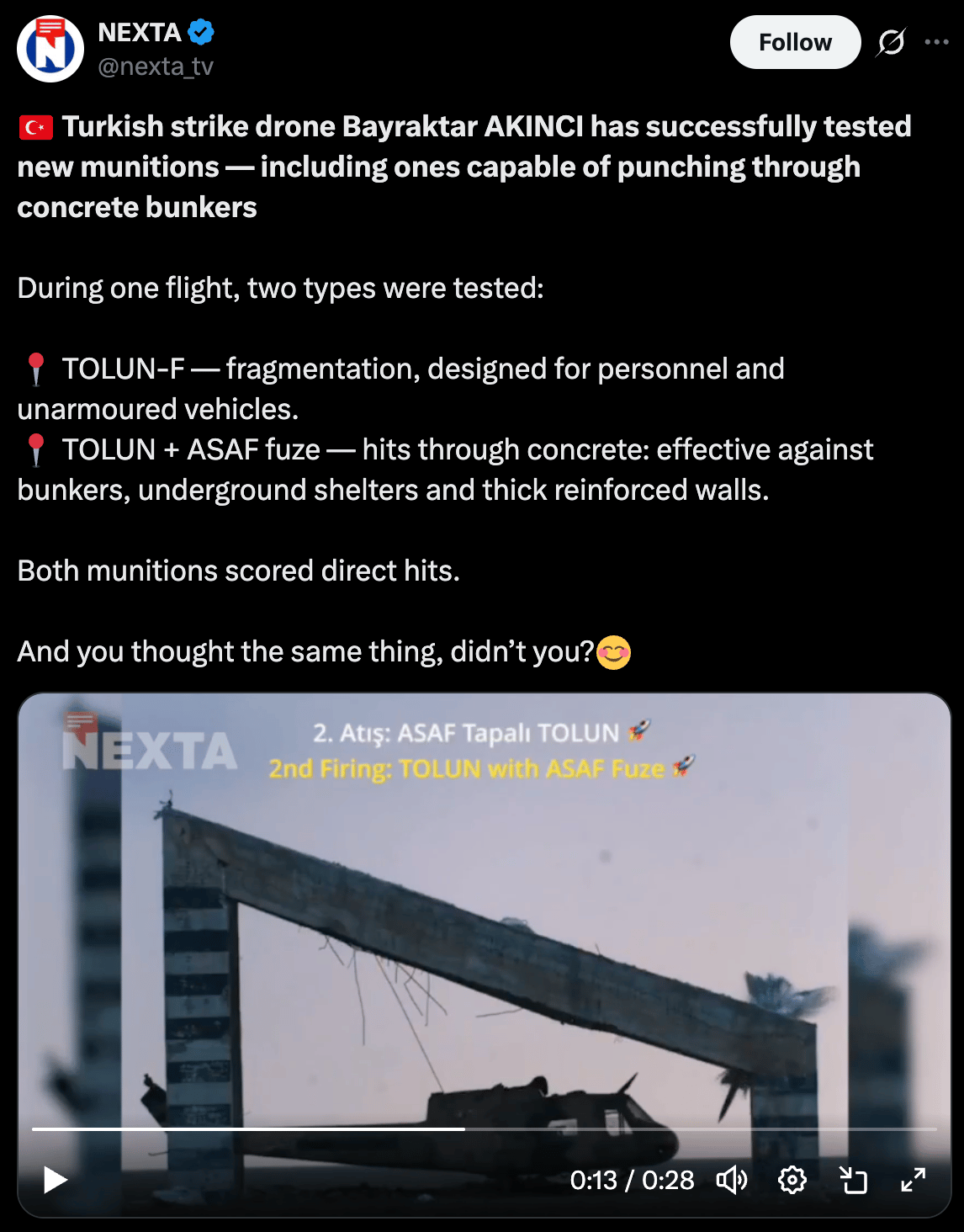
Bayraktar AKINCI strike drone tested new munitions, including TOLUN-F fragmentation rounds for personnel and unarmored vehicles, and TOLUN with ASAF fuze for penetrating concrete bunkers, underground shelters, and reinforced walls. Both achieved direct hits. This can have big implications for lightly protected bunkers for airframes, which everyone wants to build now to defend against lightweight mortar-dropping drones. So Turkey is investing heavily in this space, basically, and proving that they’re making a lot of headway.
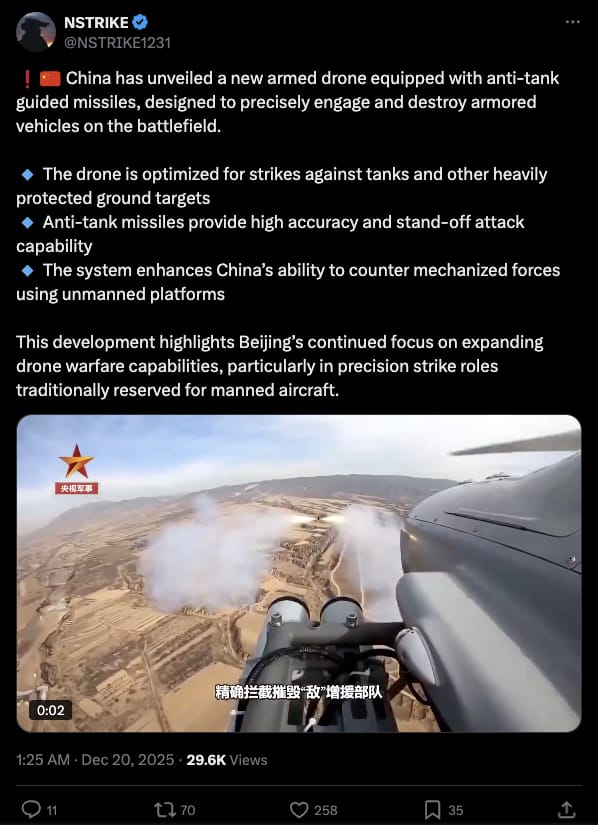
In South East Asian news, China unveiled an armed drone with anti-tank guided missiles for precise strikes on armored vehicles. The system offers high accuracy and standoff range, enhancing unmanned capabilities against mechanized forces. It also means that survivable non-attritable drones are capable of waging war on the most sophisticated armored vehicles in the Western inventory if those anti-tank missiles work as advertised.
On the ship-building front, a 65-meter semi-submersible trimaran ship appeared in China, with speculation that it operates uncrewed or as an XLUUV mothership carrying VLS cells or drone bays. It has a lot of advantages over surface ships, without needing the same kinds of complexity as a full-blown long-term sub might.

But even more interestingly, an unidentified Chinese containership carried containerized rotating AESA radar, VLS cells, CIWS, and rocket/decoy launchers for naval weaponry and ISR. This is likely just a test of the concept, but it more or less allows nearly any containership to become its own mobile, heavily armed extension of the CCP’s Navy. This is a low-cost solution, easy to retrofit existing boats, and may actually be fairly survivable.

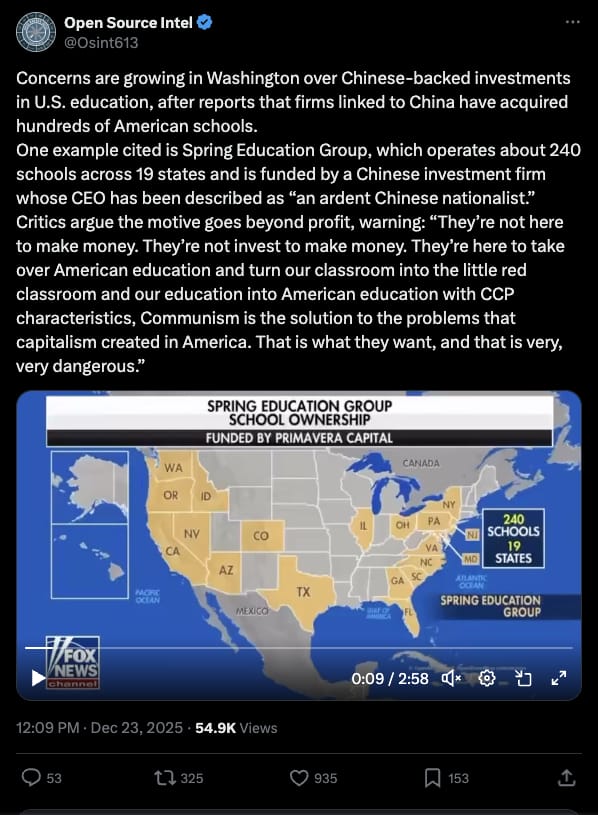
Concerns in Washington have increased regarding Chinese firms acquiring hundreds of U.S. schools, including Spring Education Group's 240 schools across 19 states, funded by a Chinese investment firm led by an ardent nationalist. Critics claim the goal is to infuse CCP-influenced communism into American education. It’s not impossible to believe that the curriculum could be infused with pro-CCP propaganda, Chinese language programs, etc.
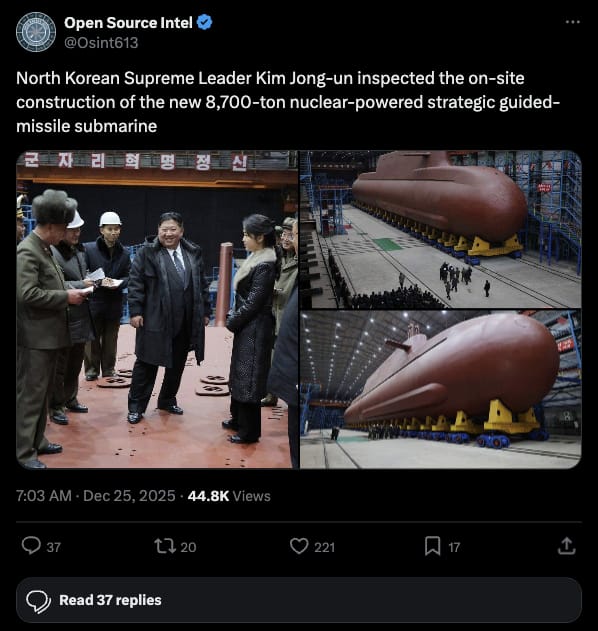
North Korean leader Kim Jong-un inspected the construction of a new 8,700-ton nuclear-powered strategic guided-missile submarine. If NK gets this operational, it allows them to have first strike capabilities on a great number of US cities, as well as our allies. It’s not ideal, though I don’t even think Kim is dumb enough to nuke a US city. ☢️
In African news, the U.S. Department of Defense released footage of a BGM-109 Tomahawk missile launch from USS Paul Ignatius in the Eastern Atlantic targeting ISIS positions in northwestern Nigeria. President Trump described a U.S. strike on ISIS in northwestern Nigeria as a Christmas gift in response to attacks on Christians. The operation targeted terrorists killing Christians. To say it another way, the United States has engaged in a holy war.

It’s hard to overstate how important this is, as we have mostly stayed out of religious disputes, sticking more to politics and right and wrong. But this wasn’t even thinly veiled, given Trump’s statement that it was intentionally done on Christmas. So, what does this mean for people living both in and outside of the US who are non-Christian? Are we going to see more strikes against those who would attack Christians, even if they are only defending themselves? It’s hard to see where this road takes us.
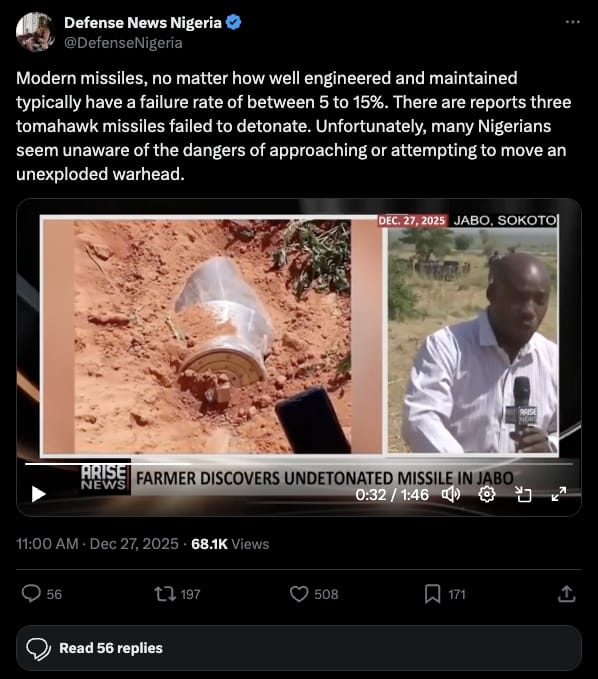
However, reports indicate a number of Tomahawk missiles from the Nigerian strike allegedly failed to detonate, with a 5-15% failure rate typical for modern missiles. Many Nigerians remain unaware of risks from unexploded warheads, though, so these are quite dangerous unless dealt with by professional EOD experts.
In Middle East news, Al-Qaeda in the Arabian Peninsula leader Saad al-Awlaki released a video threatening attacks on the U.S. and Israel, including Congress members and families, and naming U.S. cities like Philadelphia and Johnstown. The National Counterterrorism Center warned law enforcement of threats from multiple regions, including Yemen, Somalia, Pakistan, and Afghanistan, while the FBI stated al-Qaeda poses no homeland attack risk. So, I would not be surprised if we saw low-intensity attacks from lone-wolf and terror cells in the United States following this.
Over in Palestine, IDF Yahalom Unit troops dismantled over 4 kilometers of Hamas underground tunnels used for movement, storage, and attacks beneath civilian areas. The video is pretty impressive. These are huge tunnel networks, and it’s amazing how much money has been wasted on this that could have been used for the people living there.

Back to sanctioning vessels for a moment, Iran's Revolutionary Guards seized a ship carrying 4 million liters of smuggled fuel in the Arabian Gulf, with 16 foreign crew members, before it left Iranian waters.
In South of the Border news, the BELLA 1 oil tanker refused U.S. Coast Guard boarding and was in active pursuit for several days. It was eventually captured in the Atlantic. Okay, if you’re counting, that’s at least four nations seizing vessels in a week. If you don’t see a trend here, it’s worth paying attention to it, because as this increases, we’ll see less movement of cargo.
In a rather absurdist event, Venezuela's military distributed rifles to civilians in working-class neighborhoods to form local militias for armed resistance against potential foreign invasion. First of all, they have very strict gun control, so clearly they now see the utility in it. Second, I am sure leftists in Venezuela were quick to admonish the Second Amendment, and yet they are now happily arming themselves to prevent whatever may be coming. Third, Maduro is now arming the population, which could be very dangerous for him, given that an armed public won’t put up with much from their government. Lastly, in no way will a few small arms stop the US military from dropping bombs on Maduro directly. It all seems very silly. 🤡

U.S. Southern Command's Joint Task Force-Southern Spear struck a cartel narco-trafficking semi-submersible in the Eastern Pacific, killing one male narco-terrorist believed to be affiliated with a designated terrorist organization. These semi-subs are bad news, and apparently getting more common. It’s good to see a few taken off the board, especially with Chinese soft-power in the region due to their fentanyl precursors and our until-recent porous border security.

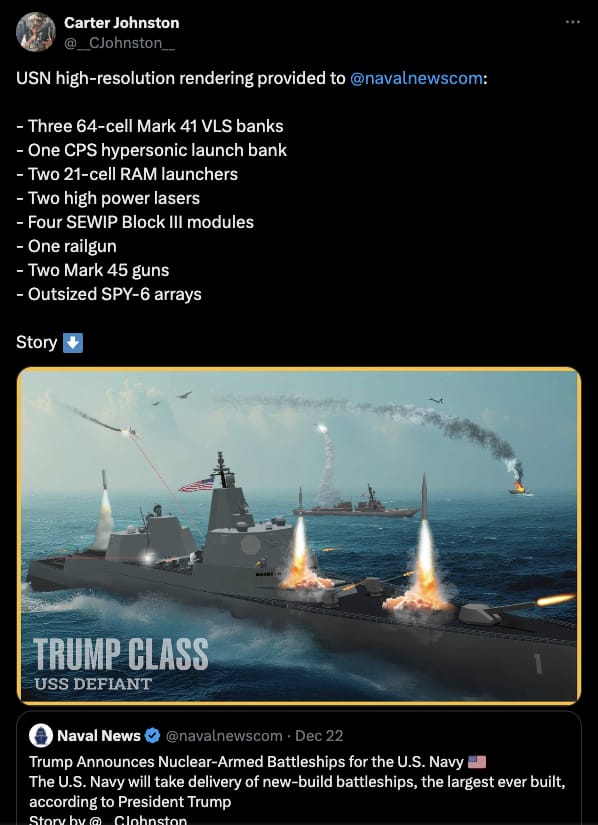
In North American news, President Trump announced the development of "Golden Fleet" battleships for the U.S. Navy, including a concept for the "Trump Class" warship USS Defiant. The design features three 64-cell Mark 41 VLS banks, one CPS hypersonic launch bank, two 21-cell RAM launchers, two high-power lasers, four SEWIP Block III modules, one railgun, two Mark 45 guns, and outsized SPY-6 arrays. Proponents argue that battleships address geography, physics, and economics for securing chokepoints like the Red Sea, providing sustained fire support, and signaling U.S. power, while countering WWII analogies by noting modern air defenses and survivability for non-peer conflicts. There are two very good writeups (and here) on how these ships actually might be a good idea even in the age of low-cost munitions. Good or bad, the one thing I have heard that is wise is the resurrection of the ship-building industry, even if it’s to build something we don’t really need for the day we do need it.
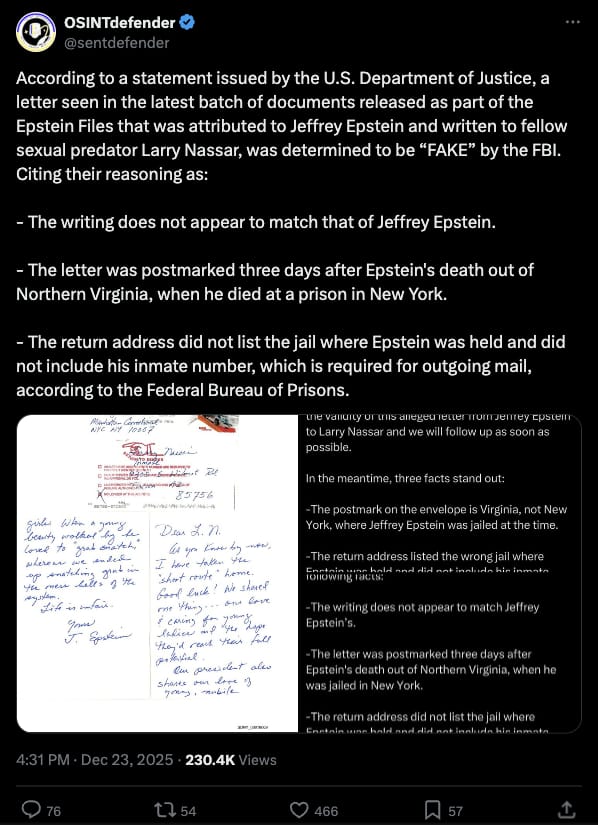
A letter attributed to Jeffrey Epstein, postmarked days after his death and addressed to Larry Nassar, claimed shared interests in young women and referenced President Trump's habits before Epstein's suicide. The FBI determined the letter is a fake due to mismatched handwriting, postmark from Northern Virginia three days after Epstein's New York death, and invalid return address not to mention lacking inmate number details which is mandatory to send letters. The Justice Department released 30,000 additional Epstein files, disclaiming unfounded 2020 election-era claims against Trump. A good friend of mine made an important point that the chain of evidence is all messed up with almost all of this information, and therefore, it’s not clear where things originated at all, and the public will assume it’s all legitimate. So, it’s worth treating everything released as suspect until it’s confirmed by other means.
The U.S. sanctioned several European and UK figures for censorship efforts, including EU Commissioner Thierry Breton for threatening X under the Digital Services Act before an Elon Musk-Trump interview; Imran Ahmed of the Center for Countering Digital Hate for de-platforming anti-vaxxers and targeting Musk's Twitter; Clare Melford of Global Disinformation Index for blacklisting sites using U.S. taxpayer funds; and Anna-Lena von Hodenberg and Josephine Ballon of HateAid for flagging content under the DSA and advocating platform regulation. I sense growing friction over censorship between the US and the EU, which was always going to come to a head given the fact that the Internet is a global system but individual laws affect nations only, not the whole Internet. I don’t see a clean solution here where both sides are happy.
Independent civilian investigators uncovered over $110 million in tax fraud in Minnesota in one day, involving corrupt politicians and fraudsters, as detailed in a 42-minute exposure video. The bad news is that this fraud is likely real and far more rampant than the video could possibly uncover, because it spans across many programs in many states.

In Tech News, Microsoft aims to replace all C and C++ code with Rust by 2030, using AI and algorithms to rewrite codebases at a rate of one million lines per engineer per month. While this likely will reduce the number of memory-related exploits, it is also quite possible that it will introduce an enormous number of new bugs in the process.
Researchers demonstrated hacking a Unitree humanoid robot via spoken commands, exploiting its embedded AI to gain full control while internet-connected. The compromised robot then spread the exploit wirelessly to an offline robot, taking control within minutes. In a test, the hijacked robot struck a mannequin, showing risks of physical harm in networked robot groups. While this is all just research, it’s horrifying. Imagine a single verbal command over radio, ad, TV, etc, that takes control over a robot in your house that then either takes over other systems wirelessly, or simply walks over to them and takes physical control over them. Pretty horrific.
Nvidia acquired Groq for $20 billion to address DRAM and HBM supply constraints in AI hardware. To be very clear, this isn’t X.com’s Grok; this is a hardware company that accelerates token generation. Groq's LPUs use on-chip SRAM without external memory, achieving 80 TB/s bandwidth versus HBM's 8 TB/s, and operate on 14nm silicon without TSMC dependency. DDR5 prices quadrupled to $27.20 in Q4 2025 due to AI-driven reallocations by Samsung, SK Hynix, and Micron, with shortages projected through 2026. I had assumed someone would pick this company up after the first time I saw them a few years back. But I assumed mostly because their token generation speed was almost an order of magnitude faster than anything else out there, not because of the cost and rarity of hardware. Very interesting stuff. It sounds like a good buy to me.
SoftBank committed $40 billion to OpenAI, with $17.5 billion already delivered and $22.5 billion due by December 31, a few short days away, after OpenAI converted to for-profit status. CEO Masayoshi Son liquidated SoftBank's staggering $5.8 billion Nvidia stake, $4.8 billion T-Mobile shares, cut staff, froze deals over $50 million, and expanded margin loans to $11.5 billion backed by Arm stock. OpenAI's valuation tripled to near $900 billion, but it projects $74 billion losses by 2028 despite $13 billion revenue, driven by compute costs for models like those competing with Google's Gemini. Altman seeks $1.4 trillion for 30 gigawatts of AI capacity, adding one gigawatt weekly at $40 billion each. More or less, this is Softbank’s last bet if they don’t get it right. That said, they are bankrolled by some very deep pockets of funds that own things like the temples in Japan.
Pwn.ai autonomously discovered and published an unauthenticated root RCE zero-day affecting over 70,000 internet-connected XSpeeder devices, marking the first AI-agent-found remotely exploitable zero-day RCE disclosed. This is history in the making but not exactly a good situation, because it does mean that there likely will be more, and a lot more.
Okay, onto the articles!
Geopolitics
Myanmar is experiencing ongoing civil conflict following a military coup that has displaced millions, leading many young people to flee to neighboring Thailand. The military is organizing an election widely perceived as illegitimate, with opposition figures barred from participation, further intensifying dissent among exiled citizens who continue to struggle for rights and safety.
The military coup in Myanmar has led to a civil war, displacing approximately 3.5 million people.
Young exiles in Thailand express disdain for the upcoming military-organized election, viewing it as a means to legitimize military rule.
[RSnake: That is a lot of people on the move. I have a feeling Thailand vs Cambodia isn’t going to make anything easier for those displaced Myanmar civilians.]
Source: https://www.aljazeera.com/features/2025/12/26/a-comedy-show-myanmar-youth-in-exile-slam-military-run-sham-election?traffic_source=rss
Tarique Rahman, a key figure in Bangladesh politics, has returned after 17 years in exile to lead his party, the Bangladesh Nationalist Party (BNP), ahead of significant general elections. His return follows the ousting of former Prime Minister Sheikh Hasina, who is currently in exile in India and facing serious criminal charges, including a death sentence for her role in political unrest that resulted in numerous deaths during her regime.
Tarique Rahman, a prominent political leader, is poised for a significant role in Bangladesh's upcoming elections.
The political landscape in Bangladesh is shifting dramatically with Hasina's ousting and her legal troubles.
[RSnake: He and his party seem relatively anti-CCP, which is good.]
Source: https://www.bbc.com/news/articles/crk733k1k1eo?at_medium=RSS&at_campaign=rss
Japan's Cabinet approved a record defense budget exceeding 9 trillion yen ($58 billion), aiming to fortify its strike-back capability and coastal defense with cruise missiles and unmanned arsenals as tensions rise in the region.
Japan plans to spend more than 160 billion yen ($1 billion) to jointly develop a next-generation fighter jet with Britain and Italy for deployment in 2035.
The budget plan allocates nearly 10 billion yen ($64 million) to support industry base and arms sales.
[RSnake: I have heard some rumblings that people feel it would be a good idea to let Japan have nukes and let them shore up their own defenses. I’m on the fence on if that is a good idea, but it likely would only make China more emboldened to increase its stance on Japan.]
Source: https://abcnews.go.com/International/wireStory/japans-cabinet-oks-record-defense-budget-aims-deter-128697811
Drone attacks in southern Russia have ignited massive fires at oil facilities near Crimea, targeting fuel infrastructure to disrupt military logistics and reduce petrochemical export revenues that help sustain Russia's invasion of Ukraine.
Russia intercepted and destroyed 141 drones during a drone strike on its oil hub in Krasnodar Krai, with the highest number of interceptions reported over Bryansk oblast.
The attack on the Temryuk seaport is part of Kyiv's deep-strike campaign to target Russian fuel infrastructure and disrupt military logistics.
[RSnake: This interception rate is still too low for Russia and likely will get worse as their air defenses get further degraded.]
Source: https://euromaidanpress.com/?p=382851
The Christian community in Gaza is facing a somber Christmas this year due to ongoing violence and humanitarian crises, leading to the suspension of public celebrations. Multiple churches have been damaged, and many individuals have lost their lives, prompting a significant exodus from the area as people seek safety and medical care.
Gaza's Christian community is observing Christmas without public celebrations due to the impacts of war.
At least 53 Christians have been killed, and many have fled the region as violence persists.
[RSnake: It’s a little surprising they didn’t move long ago. Surrounded by the enemy doesn’t sound like a great idea.]
Source: https://www.zerohedge.com/geopolitical/there-nothing-celebrate-gazas-christians-mark-somber-christmas-amid-fragile-truce
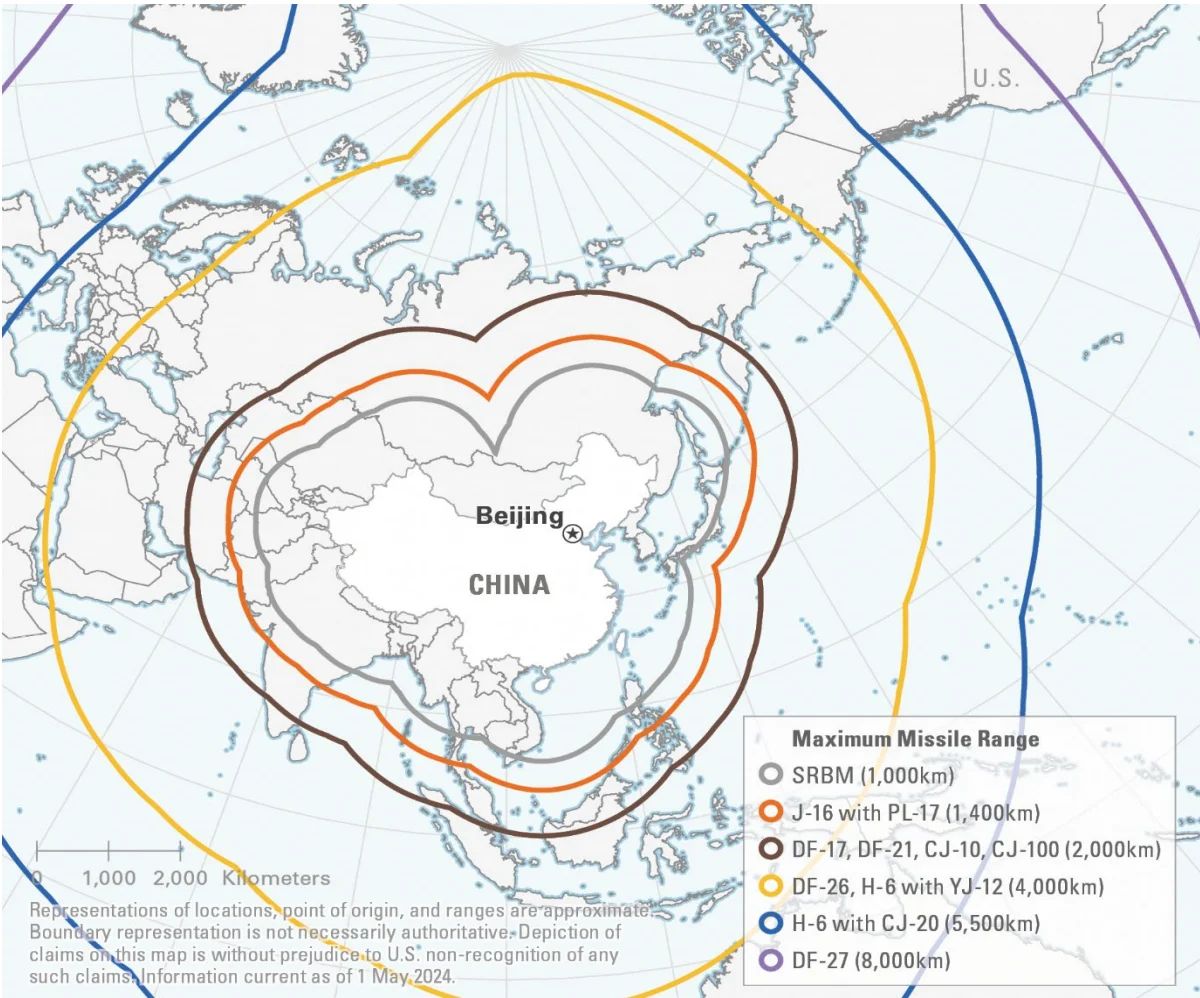
Chinese missile forces, specifically the DF-27 anti-ship ballistic missile, have been reported to possess intercontinental capabilities, reaching targets on the U.S. West Coast. This development indicates a significant enhancement in China's military capacity to threaten maritime operations across the Indo-Pacific region.
The DF-27 missile can strike targets between 5,000 to 8,000 kilometers away.
China's deployment of this missile alters the naval balance of power in the Pacific.
[RSnake: This China-centric graphic gives you a much better perspective on how far mainland based munitions can go.]
Source: https://news.usni.org/?p=119931
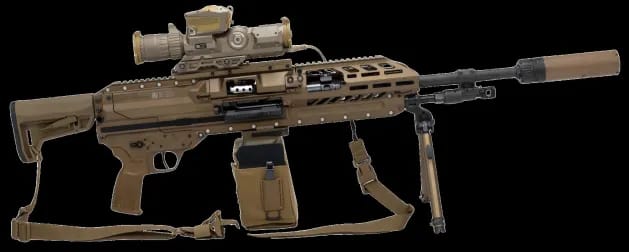
The US military has introduced the M250, a new belt-fed automatic rifle designed for modern combat, offering improved accuracy, range, and lethality compared to legacy squad weapons.
The US Army has introduced the M250, a new belt-fed automatic rifle chambered in 6.8mm, designed for modern combat scenarios with improved accuracy, range, and lethality.
The M250 is built around the same ammunition as the M7 rifle, giving squads a matched set of tools designed for the same engagement envelope and ballistic performance.
[RSnake: It’s gonna be heavier, but I think there’s something to having more firepower per soldier.]
Source: https://sofrep.com/?p=224141
The United States is currently facing a two-nuclear-peer threat for the first time, with China and Russia expanding their nuclear arsenals, prompting a reassessment of U.S. nuclear strategy and posture. As both countries enhance their capabilities, scientists and policymakers emphasize the necessity for significant updates to U.S. nuclear forces, including strategic and nonstrategic weapons, to ensure effective deterrence and national security in an increasingly complex global landscape.
The U.S. is confronted with simultaneous nuclear threats from China and Russia, necessitating an urgent update to its nuclear strategy.
Current U.S. nuclear capabilities are deemed insufficient to deter the evolving nuclear challenges posed by these adversaries.
[RSnake: As much as people fantasize about Russia disappearing due to losing badly against Ukraine, I just don’t think that’s reality. We will have two near-peer threats and a couple of rogue states, so we need to really get very clear on what we really think we can do and what influence we really can have given the threats we have.]
Source: https://www.realcleardefense.com/articles/2025/12/24/nuclear_priorities_for_the_trump_administration_a_time_to_decide_1155215.html
The US is seeking to strengthen its ties with India through the Quad alliance, but its proposals have mixed signals and may be conditional on India playing a more active military role in the South China Sea. Pakistan-US ties have strengthened despite being troubled, leading to talk of Pakistan offering the US a presence in the region. The US wants India to contribute to Indo-Pacific security and form coalitions with European and Asian allies.
The US wants India to contribute to Indo-Pacific security through continued quadrilateral cooperation with Australia, Japan, and the United States.
The US proposes forming coalitions with cooperating countries to build export markets using comparative advantages in finance and technology.
[RSnake: It’s hard to be a partner to India while we are reducing immigration and disallowing their purchase of Russian oil. But it is worth trying.]
Source: https://www.zerohedge.com/geopolitical/washingtons-national-security-strategy-sends-mixed-signals-india
The TAZARA railway, which connects Tanzania and Zambia, is set to undergo a major refurbishment with a $1.4 billion investment from the China Civil Engineering Construction Corporation (CCECC) to improve its infrastructure and operational capacity. The railway has faced ongoing challenges, including delays, accidents, and declining freight performance, which the investment aims to address by modernizing the tracks and adding new locomotives. This redevelopment is part of broader economic interests linking Zambian copper exports to global markets via Tanzania's port.
The railway has been crucial for transportation between Tanzania and Zambia but has struggled with safety and reliability issues.
China's investment is aimed at overhauling the railway to facilitate the export of Zambian copper, reflecting geopolitical and economic motivations.
[RSnake: This is part of China’s belt and road initiative, if not directly, then in a round about way.]
Source: https://www.aljazeera.com/features/longform/2025/12/28/the-tazara-turns-50-riding-the-railway-that-bridges-tanzania-and-zambia
US President Donald Trump ordered air strikes in Nigeria targeting ISIL, claiming the group kills innocent Christians, sparking questions about its purpose and potential impact on the African country with a complex religious makeup.
The US president claims the strikes are against ISIL's killing of Christians.
Many say Trump was pressured by his right-wing Christian base in the US to carry out the recent attacks in Nigeria.
[RSnake: As I said, we engaged in a holy war. I highly doubt it will be the last such instance.]
Source: https://www.aljazeera.com/video/inside-story/2025/12/27/do-donald-trumps-strikes-in-nigeria-serve-any-purpose?traffic_source=rss
Cybersecurity
The Russian-appointed head of Crimea has extended internet restrictions in the region until the end of Russia's war, and Ukraine is struggling to provide basic services due to these restrictions. Internet shutdowns are being used as an instrument of repressive and preventive policy.
Internet restrictions in occupied Crimea have been extended until the end of Russia's war, causing disruptions to basic services.
Mobile internet is considered a risk because it allows the population to self-organize and document abuses.
[RSnake: This kind of censorship also makes it virtually impossible for any of the non-military high-tech organizations to function.]
Source: https://www.pravda.com.ua/eng/news/2025/12/26/8013433/
Deepfakes have reached a level of quality that allows them to convincingly mimic real people, leading to a dramatic increase in their use and potential for deception. The volume of deepfakes has surged, with estimates showing an increase from approximately 500,000 in 2023 to around 8 million in 2025, alongside advancements in both video and voice generation technologies. This evolution poses challenges for media verification and cybersecurity as the technology becomes more accessible and integrates into everyday communication.
Deepfakes have become nearly indistinguishable from real media, increasing their potential for misuse.
The dramatic rise in the production of deepfakes poses significant challenges to media authenticity and verification.
[RSnake: I just posted something on LinkedIn about fake Subaru motorhome movies that are all over YouTube. We’re going to see a lot more of this crap.]
Source: https://gizmodo.com/?p=2000703649
Connected autonomous vehicles (CAVs) are increasingly vulnerable to sophisticated physical adversarial attacks that exploit human perception. A new framework, PHANTOM, can manipulate these vehicles' vision systems without requiring access to the underlying models, which may lead to significant safety risks and network-wide disruptions. Evaluations reveal that the effectiveness of these attacks can remain high under various conditions, showcasing critical weaknesses in CAV technology.
PHANTOM manipulates perception to deceive CAV systems.
Attacks can trigger widespread communication failures in CAV networks.
[RSnake: It’s amazingly cool tech, but in the face of adversaries, there are quite a few very serious concerns.]
Source: https://arxiv.org/abs/2512.19711
Ubisoft's Rainbow Six Siege game is currently experiencing a major crisis due to a large-scale hack or exploit, resulting in full service outages across all platforms and billions of in-game credits being awarded to players.
Players are receiving massive amounts of R6 Credits, Renown, Alpha Packs, and exclusive items unexpectedly, and some accounts have even received random bans.
The game's core services, including authentication, in-game store access, and matchmaking, are currently offline, with overall connectivity marked as degraded.
[RSnake: This ended up in a rollback of the hacked and spent credits received from the hackers.]
Source: https://www.shanethegamer.com/esports-news/rainbow-six-siege-hacked-global-server-outage/
In Russia, over 50,000 counterfeit documents, including identity cards and diplomas, were seized from an underground printing operation in Moscow. The operation generated more than 2.6 billion rubles in profit and involved at least 14 arrests, with legal actions in progress against additional suspects.
More than 50,000 counterfeit documents were confiscated from a fake printing shop.
The counterfeit operation made over 2.6 billion rubles in profit and involved multiple arrests.
[RSnake: Probably a lot of them are trying to evade going into government/military operations.]
Source: https://kazan.mk.ru/incident/2025/12/26/v-tatarstane-izyali-falshivki-izgotavlennye-v-chernoy-tipografii-v-moskve.html
A Canadian fiddler was wrongly branded a convicted sex offender by Google’s AI Overview feature, leading to concert organizers canceling a gig. The error was caused by mixed-up biographies of the same person with similar names from eastern Canada. Google has since amended search results and offered an apology.
Google’s AI Overview feature misidentified a Canadian fiddler as a convicted sex offender due to mixed-up biographies of the same person with similar names.
The error caused concert organizers to cancel a gig and led to the musician experiencing harm to his reputation, livelihood, and personal safety.
[RSnake: When AI questions about one person lead to hallucinations and those hallucinations have real world-impacts on actual people… yeah, not good.]
Source: https://gizmodo.com/?p=2000703286
Amazon has identified and blocked over 1,800 attempts by North Korean spies to infiltrate its recruitment pipeline since April 2024. Meanwhile, the FBI has seized a domain used in a phishing operation that stole bank credentials, resulting in over $14 million in losses to U.S. victims. Additionally, there is a new initiative aimed at improving cybersecurity in rural water utilities across the U.S., responding to increased threats from foreign adversaries.
Amazon has blocked thousands of North Korean spy recruitment attempts.
The FBI has taken down a phishing operation that resulted in significant financial losses.
A new program is being launched to enhance cybersecurity for rural water utilities in response to foreign threats.
[RSnake: This is from Matt Johansen’s newsletter. The 1,800 number is a lot! Imagine how many other organizations are infiltrated by North Korea, let alone other unfriendly nations.]
Source: https://www.vulnu.com/p/vulnerable-u-148
Technology
Nvidia has acquired Groq's intellectual property and key personnel for $20 billion, while intentionally leaving behind Groq's cloud business to avoid regulatory scrutiny. This strategic move allows Nvidia to strengthen its position in AI inference technology by capitalizing on Groq's unique architecture, which leverages on-chip memory to enhance performance and efficiency.
Nvidia paid $20 billion for Groq's technology and leadership but did not acquire the company itself.
The deal's structure avoids traditional regulatory reviews, allowing Nvidia to quickly integrate Groq's innovations without the associated geopolitical entanglements.
[RSnake: This blog post does a nice job of explaining both the acquisition but also why they didn’t technically acquire the entire company, just IP and the the staff, but not the cloud.]
Source: https://ossa-ma.github.io/blog/groq
AI gadgets continue to disappoint, with many relying on cloud processing and Bluetooth connections, while others make misleading claims about their capabilities.
Some AI translators may not be able to process information locally on the device, instead relying on cloud connections or Bluetooth links to function.
The lack of clear and transparent information about how certain devices work can make it difficult for consumers to trust their claims.
[RSnake: The lag and inability to work in off-line mode makes them pretty useless for real world applications that business people need, while they are on the road for instance.]
Source: https://gizmodo.com/?p=2000701432
Mathematicians have evolved their understanding of space through the concept of manifolds, which was developed by Bernhard Riemann in the mid-19th century. This has influenced various fields including geometry, topology, and physics, allowing for the exploration of higher-dimensional spaces and abstract mathematical structures foundational to modern science. Manifolds have become crucial for understanding complex systems and phenomena across mathematics and physics.
Manifolds allow mathematicians to explore complex geometric shapes and their properties.
The concept of manifolds is foundational in the fields of geometry, topology, and physics, influencing modern scientific understanding.
[RSnake: Kinda an interesting article on the foundations of this mathematical theory.]

AlphaFold has significantly advanced the fields of biology and chemistry by accurately predicting protein structures and expanding its capabilities to DNA, RNA, and drug interactions. This system, developed by DeepMind, is now used by millions of researchers globally and aims to transform scientific processes by integrating AI into research methodologies, which may lead to breakthroughs in medicine and personalized treatments.
AlphaFold has created a database of over 200 million predicted protein structures used by researchers worldwide.
The system's new developments include creating an 'AI co-scientist' that helps generate and validate scientific hypotheses.
[RSnake: This was previously thought to only be solvable through quantum algorithms, and now we have it solved with AI. It leaves some big questions about what the killer use cases for quantum computers are.]
Source: https://www.wired.com/story/alphafold-changed-science-after-5-years-its-still-evolving/
Researchers at the University of Bonn have developed a new fish-inspired filter that effectively removes over 99% of microplastics from washing machine wastewater, a significant source of environmental pollution. This innovation aims to mitigate the spread of microplastics, which are being increasingly detected in human and animal tissues and are associated with health risks.
A new filter design inspired by fish gill systems can capture microplastics from washing machine waste.
The development aims to address the environmental issue of microplastic pollution and its potential health risks.
[RSnake: That’s a clever idea, and might actually be beneficial to everyone.]
Source: https://scitechdaily.com/scientists-develop-new-fish-inspired-filter-that-removes-over-99-of-microplastics/
A Gen Z co-founder discusses the perception of her generation as overly reliant on artificial intelligence, asserting that they are actually fluent in AI and using it to enhance their cognitive capabilities rather than circumventing work. She emphasizes the importance of adapting to the rapid advancements in AI technology and the new demands that come with it in the workplace.
Gen Z workers view artificial intelligence as a collaborative tool rather than a shortcut.
The rapid evolution of AI technology creates pressure on workers to keep pace or risk obsolescence.
[RSnake: I have had a long conversation with some old-timey security people about this, and I think it solves this problem and a different one, which is that it also allows us to spend more time thinking about HOW something should work, not just the high level of what it should do, leaving only implementation details to the LLMs.]
Source: https://fortune.com/2025/12/25/gen-z-founder-ai-anxiety-obsolescence-biggest-misconception-shortcut-lazy/
A chaotic livestream of a Tesla Cybertruck driving forward with a person on the hood has sparked outrage and raised questions about online accountability and real-world danger. The incident was broadcast live on social media, and footage showed that the Cybertruck moved forward as someone appeared to fall beneath it. Fellow streamer Adin Ross advised Clavicular to continue recording while avoiding public statements.
Clavicular claims fear drove his actions, alleging he believed individuals surrounding his vehicle were armed.
The incident has raised serious questions about online accountability and real-world danger.
[RSnake: He sounds like a real piece of work. From the looks of it, it’s not the Cybertruck’s fault, but rather he should have taken control and stopped it when someone jumped on the hood. Here’s the video.]
Source: https://timesofindia.indiatimes.com/world/us-streamers/clavicular-breaks-silence-with-self-defense-claim-following-disturbing-cybertruck-livestream-moment/articleshow/126180932.cms
Business
Sears is down to its last five stores in the U.S., signaling the near end of a once-dominant retailer. The related real estate investment trust, Seritage Growth Properties, is now selling off its assets to pay down significant debt, concluding a long period of decline initiated by hedge fund manager Edward Lampert's ownership.
Sears, once a leading retailer, faces imminent closure with only a handful of stores remaining.
Seritage Growth Properties is liquidating its assets to settle debts, marking the end of a lengthy saga surrounding Sears.
[RSnake: Pretty sad. I used to do quite a bit of work for Sears once upon a time, back in my consulting days. They just don’t make sense in a world where malls are declining in popularity by the day.]
Source: https://www.nytimes.com/2025/12/26/business/sears-seritage-edward-lampert.html
Billionaires in California are considering leaving the state due to a proposed wealth tax that could affect residents worth over $1 billion, with potential tax bills of over $1 billion for some individuals.
A proposed ballot measure in California could tax residents worth over $1 billion at 5% of their assets, affecting billionaires like Peter Thiel and Larry Page.
Some billionaires are considering cutting or reducing ties to California due to the potential tax bill, with some already exploring options to leave the state.
[RSnake: I’d leave if I were them, too. That said, things like this tend to still take effect years after you are physically no longer a resident of California.]
Source: https://www.nytimes.com/2025/12/26/technology/california-wealth-tax-page-thiel.html
A growing number of countries are considering repealing their anticircumvention laws, which would allow them to modify devices and services without permission from manufacturers, potentially disrupting the digital lock industry that has amassed hundreds of billions of dollars in ill-gotten wealth. Countries like Canada, Mexico, Denmark, Nigeria, Brazil, and Costa Rica are exploring this option as a way to mitigate the harm caused by tariffs and protect their domestic tech sectors. The country that gets it right first will enjoy significant benefits, including cheaper goods and a more stable domestic tech sector.
Countries like Canada, Mexico, Denmark, Nigeria, Brazil, and Costa Rica are exploring the option of repealing their anticircumvention laws to disrupt the digital lock industry.
The repeal of these laws could lead to cheaper goods and a more stable domestic tech sector for countries that adopt it first.
[RSnake: That’s a great idea if you want sanctioned countries to profit from short-term gain. That said, incentives are all over the place here so I don’t exactly blame them either. Just don’t be surprised if they end up with very dangerous equipment ending up in their supply chain.]
Source: https://www.wired.com/story/us-trade-dominance-will-begin-to-crack/
In 2026, the venture capital landscape is shifting towards a demand for founders who can demonstrate sustainable growth and distribution advantages. Investment opportunities are expanding globally, with rising interest in markets outside the U.S., such as Latin America and the Middle East, and a significant resurgence of IPOs is anticipated, including in regions not traditionally known for tech listings.
The venture capital market is becoming increasingly selective, with higher expectations for founders' track records and business models.
Global investment is shifting, with notable activity anticipated in regions like Latin America and the Middle East, reflecting a broader diversity in emerging tech companies.
[RSnake: Growing outside the US, yes, but the US is still leading the pack for all kinds of reasons.]
Source: https://techcrunch.com/?p=3078787
Oracle's stock is experiencing a significant drop, facing its worst quarterly performance in over two decades due to delayed AI infrastructure projects and weaker earnings. Investors are increasingly skeptical about Oracle's ambitious AI investments, which have been hampered by labor shortages and rising debt from substantial capital expenditures planned for the coming years.
Oracle's stock has fallen about 30% this quarter, marking its steepest drop in 20 years.
The company is facing investor skepticism over its delayed AI infrastructure projects and increased debt.
[RSnake: That may be the first of the bubble popping, but while it’s a big drop, it’s still up YoY.]

Silver prices have reached an all-time high, increasing by 169% in 2025, while other precious metals also saw significant gains. Geopolitical tensions have escalated with U.S. military actions in Nigeria and heightened pressure on Venezuela, driving investors towards safe-haven assets like precious metals. Concerns over rising debt levels and inflation are emerging as key factors influencing market behavior and asset valuations.
Silver prices soared by 9.6% to surpass $78 per ounce, marking the highest level ever recorded.
Geopolitical tensions are increasing, particularly with U.S. military actions abroad and economic pressures on countries like Venezuela.
Growing concerns regarding national debt and inflation are leading investors to favor precious metals over traditional currencies.
[RSnake: That’s a pretty significant increase. A number of family members got silver for Xmas, and I can’t help but think it’s because it’s actually a good investment.]
Source: https://fortune.com/2025/12/26/silver-prices-gold-platinum-palladium-debt-fears-geopolitical-tensions-send-precious-metals-venezula-nigeria-strikes/
Got a useful tip? Looking to chat with me? Click here.
Check out the RSnake Show as well.
Full Disclosure: None of this is advice. This newsletter is strictly educational and my opinions. Please be careful, do your own research, and consult a professional before taking action on anything posted here.